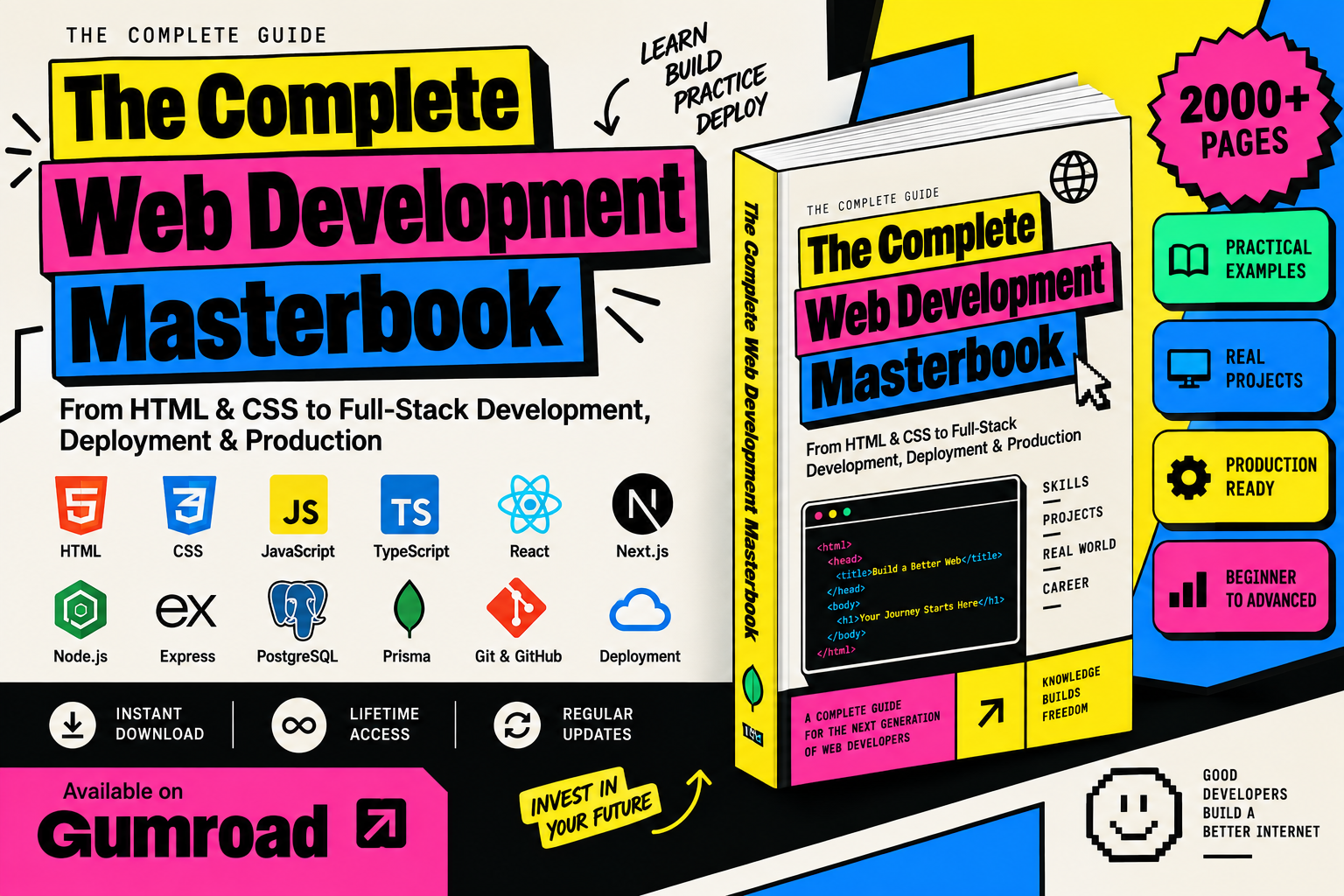
The Complete Web Development Masterbook
From HTML & CSS to Full-Stack Development, Deployment & Production
The Complete Web Development Masterbook is a comprehensive, practical guide designed to take a learner from the fundamentals of web development to building, deploying, and maintaining modern full-stack web applications.
Starting with the foundations of HTML and CSS, the book progressively covers JavaScript, Git and GitHub, TypeScript, React, modern frontend development, Next.js, Node.js, Express, REST APIs, databases, SQL, authentication and authorization, full-stack integration, deployment, security, performance, and production practices.
Rather than treating technologies as isolated subjects, the book connects them into a complete development workflow. Concepts are explained clearly, followed by practical examples, code, architecture patterns, common mistakes, debugging techniques, and real-world implementation.
What You Will Learn
- Build structured and accessible websites with HTML5
- Create responsive and modern interfaces with CSS
- Program interactive applications with JavaScript
- Manage projects professionally with Git & GitHub
- Write scalable, type-safe applications with TypeScript
- Build component-based interfaces with React
- Develop modern applications using Next.js
- Create backend applications with Node.js and Express
- Design and consume REST APIs
- Work with PostgreSQL and SQL
- Use Prisma and database-driven architectures
- Implement secure authentication and authorization
- Connect frontend, backend, APIs, and databases into complete applications
- Apply modern security, performance, testing, and architecture practices
- Deploy applications to production
- Build and present a professional full-stack portfolio project
Learning Philosophy
The book follows a fundamentals → concepts → examples → implementation → projects → production approach.
It focuses on understanding why technologies and techniques are used, not simply memorizing syntax. Each major technology builds upon the previous one, creating a continuous path from writing your first HTML page to developing a complete production-ready full-stack application.
By the end, you should have the knowledge and practical foundation required to continue learning independently, build real-world projects, contribute to professional codebases, and progress toward becoming a modern full-stack web developer.
Table of Contents
The Complete Web Development Masterbook
From HTML & CSS to Full-Stack Development, Deployment & Production
PART I — WEB FOUNDATIONS
1. Introduction to Web Development
2. How the Web Works
3. Browsers, Servers & HTTP
4. Development Environment & Tools
5. Web Development Workflow
6. Developer Tools & Debugging Fundamentals
PART II — HTML
7. Introduction to HTML
8. HTML Document Structure
9. Text & Content Elements
10. Links & Navigation
11. Images & Media
12. Lists
13. Tables
14. Forms & Form Controls
15. Semantic HTML
16. HTML Attributes & Global Attributes
17. Accessibility Fundamentals
18. HTML SEO Fundamentals
19. HTML Best Practices
PART III — CSS
20. Introduction to CSS
21. CSS Syntax & How CSS Works
22. Selectors
23. Cascade, Inheritance & Specificity
24. Colors & Backgrounds
25. CSS Units
26. Typography
27. Box Model
28. Display & Sizing
29. Positioning & Layering
30. Flexbox
31. CSS Grid
32. Flexbox vs Grid
33. Responsive Web Design
34. Media Queries
35. Modern Responsive CSS
36. Pseudo-Classes
37. Pseudo-Elements
38. Borders, Shadows & Visual Effects
39. Transitions & Transforms
40. CSS Animations
41. CSS Variables & Theming
42. Modern CSS Features
43. CSS Architecture & Organization
44. CSS Debugging
45. HTML & CSS Projects
---
PART IV — JAVASCRIPT
46. Introduction to JavaScript
47. JavaScript Syntax & Fundamentals
48. Variables & Data Types
49. Operators & Expressions
50. Strings & Numbers
51. Type Conversion & Coercion
52. Conditional Statements
53. Loops
54. Functions
55. Scope & Closures
56. Arrays & Array Methods
57. Objects
58. Destructuring, Spread & Rest
59. this Keyword
60. Prototypes & Classes
61. Error Handling
62. Debugging JavaScript
63. DOM Fundamentals
64. DOM Manipulation
65. Events & Event Handling
66. Forms & Validation
67. Browser Storage
68. JSON
69. Asynchronous JavaScript
70. Promises
71. Async/Await
72. Fetch API
73. Working with REST APIs
74. ES Modules
75. Modern JavaScript Patterns
76. Dates, Regular Expressions & Useful APIs
77. JavaScript Projects
---
PART V — GIT & GITHUB
78. Version Control Fundamentals
79. Git Installation & Configuration
80. Repositories & Commits
81. Git Workflow
82. Branches
83. Merging & Conflict Resolution
84. GitHub Fundamentals
85. Remote Repositories
86. Clone, Push, Pull & Fetch
87. SSH & Authentication
88. Pull Requests & Collaboration
89. Stash, Reset, Restore & Revert
90. Rebase & Cherry-Pick
91. Tags & Releases
92. GitHub Actions Introduction
93. Professional Git Workflow
---
PART VI — TYPESCRIPT
94. Introduction to TypeScript
95. TypeScript Setup & Compilation
96. Types & Type Inference
97. Arrays, Tuples & Objects
98. Type Aliases & Interfaces
99. Union & Intersection Types
100. Type Narrowing
101. Functions & Function Types
102. Generics
103. keyof, typeof & Indexed Access Types
104. Utility Types
105. Mapped & Conditional Types
106. Enums & Literal Types
107. Classes & Object-Oriented TypeScript
108. Modules
109. tsconfig.json
110. TypeScript with DOM
111. TypeScript with APIs
112. TypeScript with React & Node.js
113. JavaScript-to-TypeScript Migration
114. TypeScript Best Practices
---
PART VII — REACT
115. Introduction to React
116. React Mental Model
117. React Setup with Vite
118. JSX
119. Components
120. Props
121. State & useState
122. Events
123. Conditional Rendering
124. Lists & Keys
125. Forms
126. Hooks
127. useEffect
128. useRef
129. Performance Hooks
130. Context API
131. Custom Hooks
132. API Data Fetching
133. React Router
134. Protected Routes
135. State Management
136. Redux Toolkit & Zustand
137. React Performance
138. Lazy Loading & Code Splitting
139. Error Boundaries
140. Accessibility in React
141. Testing React Applications
142. React Architecture
143. Complete React Projects
---
PART VIII — MODERN FRONTEND DEVELOPMENT
144. Modern Frontend Architecture
145. npm & Package Management
146. package.json & Dependencies
147. Vite & Build Tools
148. Frontend Application Architecture
149. API & Service Layers
150. Client State vs Server State
151. TanStack Query
152. Modern Forms & Validation
153. Responsive UI Architecture
154. Accessibility
155. Frontend Security
156. Web Performance
157. Browser Rendering & Loading
158. Storage & Browser APIs
159. Routing & URL State
160. Loading, Error & Empty States
161. Design Systems & Component Libraries
162. Testing Strategy
163. ESLint, Prettier & Code Quality
164. CI/CD Fundamentals
165. Production-Ready Frontend Architecture
---
PART IX — NEXT.JS
166. Introduction to Next.js
167. Next.js Project Setup
168. App Router
169. File-Based Routing
170. Layouts & Templates
171. Server & Client Components
172. Data Fetching
173. Rendering Strategies
174. Caching & Revalidation
175. Navigation & Redirects
176. Loading & Error UI
177. Route Handlers
178. Server Actions
179. Search Params & URL State
180. Metadata & SEO
181. Images, Fonts & Assets
182. Authentication Foundations
183. Middleware/Proxy Concepts
184. Database Integration
185. Next.js Security
186. Next.js Performance
187. Testing & Deployment
188. Complete Next.js Project
---
PART X — NODE.JS
189. Introduction to Node.js
190. Node.js Architecture
191. V8, libuv & the Event Loop
192. Node.js & npm
193. Modules: ESM & CommonJS
194. File System
195. Paths & URLs
196. Events & EventEmitter
197. HTTP Servers
198. Async Programming
199. Error Handling
200. Environment Variables & Configuration
201. Node.js Fetch
202. Streams & Buffers
203. Cryptography Fundamentals
204. Process & OS Modules
205. Logging
206. Node.js Security
207. Testing & Debugging
208. Performance & Graceful Shutdown
209. Complete Node.js Backend Project
---
PART XI — EXPRESS
210. Introduction to Express
211. Express Setup with TypeScript
212. Express Application Structure
213. Routing
214. Request & Response
215. Middleware
216. Routers
217. Controllers & Services
218. Validation with Zo